General relativity is, by wide consensus among physicists, one of the most beautiful and elegant physical theories we possess. The connection it draws between the curvature of spacetime and the motion of freely falling bodies has an almost miraculous quality: there is something deeply compelling, perhaps even inevitable, about the way the theory holds together.
That said, general relativity is also wrong, or at least incomplete: as far as we know, it is not compatible with quantum mechanics in any fully satisfactory way. A deeper, more fundamental theory must underlie both. Nonetheless, the predictions of general relativity have been confirmed to extraordinary accuracy across an enormous range of cosmological and astrophysical phenomena, and it remains the indispensable framework for understanding gravity.
Text. Wald, General Relativity . We follow Wald closely,
though we deviate where other sources offer clearer treatments.
Other sources:
Misner, Thorne & Wheeler : the “telephone book,” a comprehensive and physically rich discussion of general relativity.
Weinberg : an excellent resource for explicit calculations.
Structure. The course proceeds from mathematical methods to the physics of gravitation. The emphasis falls deliberately on the mathematical side: in particular, on differential geometry. While it is perfectly possible to do general relativity concretely, working in a single coordinate patch and never invoking coordinate-free notation, a command of the underlying differential geometry is indispensable for further studies in theoretical physics. Anytime one wishes to do serious work in quantum gravity or string theory, fluency in differential geometry is a prerequisite; the investment made here will pay dividends well beyond this course.
Videos. Lenny Susskind’s lecture series on general relativity offers an absolutely different, and completely complementary, perspective to the one presented here.
Prerequisites:
Special relativity
Calculus
Linear algebra
Combinatorics
Assumption: Newtonian physics presupposes the existence of a preferred reference system and clocks. This is the core assumption that will be broken in the transition from pre-relativity to relativity physics: a common thread in the development of physics is that one makes (often implicit) assumptions in a physical theory, and as one learns more about the universe one is forced to re-evaluate and potentially discard them.
A free test mass (i.e. no force acts) moves along a straight trajectory at a constant rate, uniformly in time: constant displacement per unit time. This defines an inertial reference frame. There is one preferred reference frame, but one can obtain others by performing Galilean boosts: an observer moving at constant velocity with respect to the preferred frame will also see free test masses moving along straight trajectories at constant rates.
Newton’s second law is written with respect to an inertial reference system: \[\label{eq:newton2} \boxed{\boldsymbol{F}(\boldsymbol{x}(t),\, t) \;=\; m_I\, \ddot{\boldsymbol{x}}(t)\,,}\] where \(\boldsymbol{F}\) is the force, \(m_I\) is the inertial mass, and \(\ddot{\boldsymbol{x}}\) is the acceleration.
With respect to a non-inertial reference frame, define three (time-dependent) unit vectors \(\hat{\boldsymbol{x}}'(t)\), \(\hat{\boldsymbol{y}}'(t)\), \(\hat{\boldsymbol{z}}'(t)\). A trajectory can be expressed in either basis: \[\begin{aligned} \boldsymbol{w}(t) &= w_x(t)\,\hat{\boldsymbol{x}} + w_y(t)\,\hat{\boldsymbol{y}} + w_z(t)\,\hat{\boldsymbol{z}} \label{eq:traj-inertial}\\ &= w_{x'}(t)\,\hat{\boldsymbol{x}}'(t) + w_{y'}(t)\,\hat{\boldsymbol{y}}'(t) + w_{z'}(t)\,\hat{\boldsymbol{z}}'(t). \label{eq:traj-noninertial} \end{aligned}\]
Index notation. For a vector \(\boldsymbol{a}\) and a matrix \(M\): \[[\boldsymbol{a}]_x = a_x\,,\qquad [M]_{xy} = M_{xy}\,.\]
Physics in non-inertial frames (as captured by Newton’s second law) gives rise to additional inertial force terms, e.g. centrifugal, Coriolis, Euler forces, etc.
Distinguish “true forces” from apparent (inertial) forces.
In a rotating reference frame, a ball thrown in a straight line appears to curve (Coriolis effect). The “force” causing this curve is not due to any physical interaction: it is an artefact of the non-inertial frame. In Newtonian physics, gravity is classified as a true force. A central insight of general relativity is that gravity, too, can be understood as an artefact of geometry, effectively reclassifying it alongside the inertial forces.
Inertial mass \(m_I\): the constant of proportionality in Newton’s second law, \[\label{eq:newton2-abstract} F = m_I\, a\,.\]
Active gravitational mass \(m_g^{(a)}\): the mass that produces the gravitational field that other masses respond to. The gravitational field of a point source at position \(\boldsymbol{x}'\) is \[\label{eq:grav-field-point} \boldsymbol{g}(\boldsymbol{x}) = -G\, m_g^{(a)}\, \frac{\boldsymbol{x} - \boldsymbol{x}'}{\lVert \boldsymbol{x} - \boldsymbol{x}' \rVert^3}\,,\] where \(G\) is the gravitational constant, \[G = 6.674\,30(15) \times 10^{-11}\;\mathrm{m}^3\, \mathrm{kg}^{-1}\,\mathrm{s}^{-2}\,.\]
Passive gravitational mass \(m_g^{(p)}\): the mass that responds to an external gravitational field by accelerating, \[\label{eq:grav-force} \boldsymbol{F}_g = m_g^{(p)}\,\boldsymbol{g}\,.\]
It is assumed that \(m_I,\, m_g^{(a)},\, m_g^{(p)} \geq 0\). This non-negativity is an assumption, not a theorem: one cannot deduce it from the other laws of Newtonian physics.
It is possible to build a consistent Newtonian physics with negative masses. The consequences are exotic: negative masses behave somewhat like negative charges, and all manner of counterintuitive phenomena arise, but the theory does not immediately break down. The non-negativity of mass is supported by extensive experimental evidence, not by logical necessity.
Using Newton’s third law, argue that mg(a)/mg(p) is a universal constant.
Choosing units: \(m_g^{(a)} = m_g^{(p)} \equiv m_g\).
Every massive body carries three logically independent numbers: how much it resists acceleration (mI), how strongly it sources a gravitational field (mg(a)), and how strongly it responds to one (mg(p)). That nature chooses to make all three equal is not obvious: it is a deep empirical fact that general relativity elevates to a geometric principle.
Extensive experimental evidence suggests \(m_g = m_I\).
In a gravitational field g, the orbit x(t) of a test mass depends only on the initial conditions. That is, identical initial conditions produce identical trajectories regardless of the composition or internal structure of the test mass.
Consider a test mass in a gravitational field:
The equation of motion reads \[\label{eq:eom-grav} m_g\,\boldsymbol{g}(\boldsymbol{x}(t)) = m_I\,\ddot{\boldsymbol{x}}(t)\,,\] or equivalently, \[\label{eq:eom-UFF} \boxed{\ddot{\boldsymbol{x}}(t) = \frac{m_g}{m_I}\,\boldsymbol{g}(\boldsymbol{x}(t))\,.}\] Since \(m_g/m_I\) is a universal constant, we may choose units such that \(m_g = m_I\).
The universality of free fall is not a consequence of Newtonian theory: it is a falsifiable hypothesis. That mg = mI cannot be proved from Newton’s laws; it is an empirical statement that could, in principle, be refuted by experiment. Experiments testing this relationship continue to this day.
UFF applies specifically to test masses. A test mass is an idealised notion: one should visualise it as a “point” particle. The concept is already subtle in Newtonian physics: a finite mass concentrated into an arbitrarily small volume would, in general relativity, form a black hole, and it becomes more so when test masses are numerous enough to generate their own gravitational fields. These subtleties will be resolved once we have the full apparatus of general relativity.
Five test particles in a Kepler field with \(\eta = m_g/m_I\) ranging from 0.85 to 1.15. If \(\eta = 1\), all orbits coincide. No deviation has ever been observed.
The equality mg = mI has been tested with extraordinary precision:
The Eötvös experiment uses a torsion balance: two masses of different composition are suspended at opposite ends of a bar. If mg/mI differed between materials, the bar would rotate. No such rotation has ever been observed . Lunar laser ranging exploits the Apollo retroreflectors to compare the free-fall accelerations of the Earth and Moon toward the Sun. The microscope satellite (2016–2018; final results published 2022) achieved the most stringent test to date, constraining the Eötvös parameter to |η| ≡ |(mg/mI)A−(mg/mI)B| < 10−15.
We now reformulate Newton’s gravity as a field theory, drawing on the analogy between Newtonian gravity and electrostatics. The motivation is direct: electrodynamics is compatible with special relativity: Lorentz transformations leave Maxwell’s equations invariant and information propagates at the speed of light. If Newtonian gravity looks structurally like electrostatics (and it does), then perhaps we can add dynamics in the same way and arrive at a relativistic theory of gravity. As we shall see, this hope is partially fulfilled: the approach does lead somewhere, but the destination is more radical than a simple gravitational analog of Maxwell’s equations.
| Electrostatics | Newtonian gravity | |
|---|---|---|
| Force law | \(\displaystyle\boldsymbol{F} = k_e\frac{q_1 q_2}{r^2}\,\hat{\boldsymbol{r}}\) | \(\displaystyle\boldsymbol{F} = -G\frac{m_1 m_2}{r^2}\,\hat{\boldsymbol{r}}\) |
| Field | \(\boldsymbol{E}\) | \(\boldsymbol{g}\) |
| Source | charge density \(\rho_e\) | mass density \(\rho\) |
| Source sign | both signs | \(\rho \geq 0\) only |
| Potential | \(V\) | \(\phi\) |
| Field from potential | \(\boldsymbol{E} = -\nabla V\) | \(\boldsymbol{g} = -\nabla\phi\) |
| Gauss’s law | \(\nabla\cdot\boldsymbol{E} = \rho_e/\varepsilon_0\) | \(\nabla\cdot\boldsymbol{g} = -4\pi G\rho\) |
| Poisson equation | \(\Delta V = -\rho_e/\varepsilon_0\) | \(\Delta\phi = 4\pi G\rho\) |
The structural parallel is almost perfect: both are 1/r2 force laws sourced by a density and governed by a Poisson equation. The crucial difference is that electric charge comes in two signs (allowing shielding and cancellation), while mass is always positive. This means gravity cannot be screened, every mass in the universe contributes, which is ultimately why a geometric description (curved spacetime) becomes necessary.
The gravitational field is a map \[\boldsymbol{g}: \mathbb{R}\times\mathbb{R}^{3} \to \mathbb{R}^{3}\,,\qquad (t,\,\boldsymbol{x}) \mapsto \boldsymbol{g}(t,\,\boldsymbol{x})\,.\]
The (gravitational) mass density is \[\rho: \mathbb{R}\times\mathbb{R}^{3} \to \mathbb{R}^+\,,\] and the field equation reads \[\label{eq:gauss-grav} \boxed{\nabla\cdot\boldsymbol{g} = -4\pi G\,\rho\,.}\]
Since \(\nabla\times\boldsymbol{g} = 0\), the field \(\boldsymbol{g}\) is conservative. By Poincaré’s lemma there exists a scalar potential \(\phi: \mathbb{R}\times\mathbb{R}^{3}\to\mathbb{R}\) such that \[\label{eq:g-from-phi} \boxed{\boldsymbol{g} = -\nabla\phi} \qquad\text{(sign convention).}\] Substituting into [eq:gauss-grav]: \[\label{eq:poisson} \boxed{\Delta\phi = 4\pi G\,\rho} \qquad\text{(Poisson's equation).}\]
\[\label{eq:eom-potential} \boxed{\ddot{\boldsymbol{x}}(t) = -\nabla\phi\big(t,\,\boldsymbol{x}(t)\big)\,.}\]
Assume \(\supp(\rho)\) is compact (closed and bounded by the Heine–Borel theorem), with \[\phi(t,\,\boldsymbol{x}) \to 0 \quad\text{as}\quad \lVert \boldsymbol{x} \rVert\to\infty\,.\] Then the unique solution to Poisson’s equation is \[\label{eq:poisson-solution} \boxed{\phi(t,\,\boldsymbol{x}) = -G\!\int_{\mathbb{R}^{3}}\!\mathrm{d}^3 x'\; \frac{\rho(t,\,\boldsymbol{x}')}{\lVert \boldsymbol{x} - \boldsymbol{x}' \rVert}\,.}\] This gives the “gravitostatic” formulation of Newtonian gravity: symbol for symbol, it mirrors electrostatics. Just as in electrostatics, the field equation, potential, and integral solution form a self-contained package. The key difference, as always, is that \(\rho \geq 0\): gravity has only one sign of “charge.”
How do we add dynamics to the gravitational field? At present, the gravitational field in our formulation is static: the Poisson equation determines \(\phi\) from the instantaneous mass distribution. But what happens when the sources move? Several approaches suggest themselves, with very different outcomes:
See Misner, Thorne & Wheeler , Chapter 7, for a detailed and beautiful discussion of all four routes.
Route (0) has obvious causality problems: by rearranging masses one could signal faster than light, violating special relativity. Route (1), promoting the Poisson equation to a scalar wave equation, is mathematically consistent but predicts no bending of light by gravity, which has been observed. Route (2), completing \(\phi\) to a 4-vector, as one does for the electromagnetic potential, suffers from negative-energy wave solutions and fails to reproduce the observed perihelion precession of Mercury. Only route (3), completing \(\phi\) to a symmetric rank-2 tensor, survives all experimental tests. Remarkably, the dynamics one is forced to write down turn out to be precisely the linearised form of Einstein’s field equations, from which the full nonlinear theory of general relativity can be recovered.
We will not follow this route to discover general relativity; it is not the path Einstein took (at least not as far as the historical record reveals). Instead, we will arrive at the theory from a completely different direction, starting from the equivalence principle in the next lecture.
A scalar field ϕ has one component: not enough to encode the geometry of a 4-dimensional spacetime. A 4-vector has four components, but leads to unphysical negative-energy solutions. A symmetric rank-2 tensor gμν has ten independent components in four dimensions: exactly the right number to describe a metric on spacetime. This is the gravitational field of general relativity.
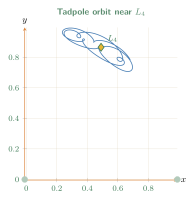
The Newtonian gravitational potential for a system of two bodies in the co-rotating frame illustrates the interplay between gravity and inertial (centrifugal/Coriolis) forces. The effective potential is \[\label{eq:Phi-eff-cr3bp} \boxed{\Phi_{\mathrm{eff}}(x,y) = -\frac{1-\mu}{r_1} - \frac{\mu}{r_2} - \tfrac{1}{2}(x^2 + y^2)\,,}\] where \(\mu = M_2/(M_1+M_2)\) is the mass ratio, and \(r_{1,2}\) are the distances to the two masses. This potential has five critical points: the Lagrange points \(L_1\)–\(L_5\). The collinear points \(L_1\), \(L_2\), \(L_3\) are saddle points (unstable), while \(L_4\) and \(L_5\) form equilateral triangles with the two masses and are linearly stable for \(\mu < \mu_{\mathrm{crit}} \approx 0.0385\).